Foreword
This research emerged from tension between my own design practice and intuitive experiential claims developed over the years. Overall, frustration with vague uses of ‘atmosphere’, ‘intimacy’, ‘phenomenology’ accumulated strongly when engaging with the current architectural discourse. While phenomenology is often invoked loosely, this research aims to define and structure it without flattening its poetic potential.
Special Thanks
I am very grateful to the Bartlett School of Architecture, my Alma Mater, for encouraging critical thinking, exposure to a vast array of theoretical concepts, and for supporting the experiential design methodology I developed while studying. I also want to give thanks to the Moscow School of Architecture for initially developing my interest in experience-forward design and equipping me with initial critical skills prior to my studies at the Bartlett. Both institutions shaped not only my architectural thinking, but my conviction that experience is never accidental in space. This work is an extension of that conviction, translating intuition into structured inquiry.
Introduction
Tensions
Architecture and human experience have always remained conjoined. What is broadly defined as phenomenology usually assumes immediate affect and embodied authenticity. When writing about architectural space, it is common to see authors taking certain experiential spatial qualities as inherent. Yet experience is never neutral or pure, as this essay aims to establish. Within this essay four authors have been brought together to introduce contrasting ways of assessing spatial experience. Beatriz Colomina destabilises neutrality through mediation and visibility regimes, claiming phenomenology cannot be viewed as innocent. Peter Zumthor operationalises atmosphere, essentially translating phenomenology into architectural assembly. Arnold Mindell provides a much needed psychoanalytic lens that grounds human experience into recognised patterns tied to space. Gaston Bachelard frames imaginal spatial figures, tackling metaphors and pre-interpretive shapes and associations. In current rhetoric each approach remains powerful but separate. There is no unified method that synthesises mediation, operation, process and image into one reading. The essay poses several key questions aiming to define phenomenology into a structured framework. If phenomenology is neither purely embodied nor purely symbolic, how can it be analysed without reduction? Are experiential qualities inherent to typology and cultural script, or structurally produced?
Propositions
This essay will propose a four-register framework. Starting with Colomina’s mediation register to set constraints, it follows with Zumthor’s operation register to assess spatial variables. In further reading, variables are assessed via Mindell’s process register with defined bodily affects identified. Lastly, Bachelard’s imaginal register locates the overarching imaginal figures synthesising previously produced knowledge and its consequences for a given space. The bedroom was chosen as a site that carries a cultural promise of intimacy as a condition. Typologically charged, it provides a comprehensive testing ground for phenomenological claims. If intimacy is inherent, both bedrooms would produce reverie. If it is assembled, divergence will emerge. Two bedrooms will be analysed against each other: the Playboy Mansion master bedroom and the monk cell at La Tourette. These bedrooms function as contrasting spatial regimes. The overall study will test whether phenomenological experience is inherent to cultural scripting or constructed through spatial mechanisms. In doing so, the essay situates phenomenology not as a descriptive discourse, but as a structured analytical and potentially generative framework.
Existing Definitions and Approaches to Phenomenology
Beatriz Colomina
For Beatriz Colomina architecture is not autonomous from mediation, but dependent on a system of ideologies and power structures. In her reading, spatial experience is constructed through visual regimes. In Sexuality and Space (1992) Colomina claims that visibility is regulated from the outset, sight lines are pre-distributed (Colomina, 1992). Thus, interiors are theatrical, where the inhabitant is both actor and spectator existing in a pre-mediated space (ibid.). Here experience is conditioned by outer power relations and politics. Moreover, privacy is presented as intentionally layered technical effect, not natural phenomenological depth. Beatriz Colomina does not outright reject phenomenology and built experience, but rather she reframes those terms, grounding and contextualising them. While spatial experience is undeniable, there is no ‘pure’ encounter outside the overarching framing (Colomina, 1992). Colomina questions stability, neutrality of spatial arrangements in Privacy and Publicity (1994). She claims that they are mediated through power, surveillance, and ideology (Colomina, 1994). That introduces contingency, forcing any spatial analysis to specify context. The stability of the subject, where there is a coherent agent of experience, is questioned as well. Architecture is claimed to position the subject, even in domestic interiors, as someone who is seen (Colomina, 1994). Reframing phenomenology here is not to deny embodiment, but to add positionality of the subject, to insert power and mediation into the subject-space relation. Colomina prevents phenomenology from claiming immediacy or neutrality.
Peter Zumthor
Peter Zumthor reframes phenomenology as atmosphere, which is an immediate and pre-reflective feeling a space produces (Zumthor, 2006). In Atmospheres (2006) Zumthor claims spatial perception as rapid emotional appraisal, which he links to the unconscious. He insists that atmospheres are tangible and constructed, not mystical. Executed through defined variables, outlined as body, material, light, objects, scale, architecture is assembled into atmospheric experience (Zumthor, 2010). Peter Zumthor both in Atmospheres (2006) and Thinking Architecture (2010) assigns genuine agency to the defined operational variables, which are used in his built work as calibrated atmospheric systems translated into corporeal terms. The body of architecture is the most extensive medium, tackling weight, density and containment. Those are described to clearly produce bodily reaction in terms of muscle tone, somatic orientation, posture (Zumthor, 2006). The body is inseparable from scale and levels of measurable intimacy, where the agents are reach, sight lines, relative proportions (ibid.). The light further tackles privacy and depth, intimacy and exposure (Zumthor, 2006). Materials and surrounding objects act as affective vessels, producing cohesion or tension, tactile invitation (Zumthor, 2006). According to Peter Zumthor’s methodology, the outlined variables shape the immediate experience of space. Zumthor intentionally operationalises phenomenology into a form of practice, not just analysis. Moreover, he frames atmospheres as qualitatively articulable variables, translating affect into built conditions. This makes space diagnosable, allowing for spatial conditions to be assessed not as subjective impressions, but as agents of experience.
Arnold Mindell
Across his works, Arnold Mindell approaches phenomenology as an unconscious process that can be tracked. In The Shaman’s Body (1993) he creates a duality of primary and secondary processes, where the latter shelter manifestations that do not fit into the person’s performed identity. In Working with the Dreaming Body (1985) Mindell defines secondary processes as a multitude of channels where information exists and is registered before meaning is assigned retrospectively. Across proprioception, vision, sound, external sensation, Mindell registers two key channels that are assigned to parallel manifestations of the unconscious – somatic and imaginal (ibid.). The somatic channel is bodily, expressed through symptoms, sensations, position, pain and physical impulses (Mindell, 1985). Opposite exists the imaginal channel, registering dream images, scenes, metaphors (ibid.). Both channels are equally truthful and must be understood as a comprehensive evidential field (Mindell, 1985). Across his bodies of work, Mindell phenomenologically tracks the secondary processes through channels and introduces amplification as a clinical method. Amplification provides a methodological link to architectural phenomenology, as space was observed to be one of the amplifying factors (Mindell, 1985). Mindell’s work reveals phenomenology as pre-interpretive and clearly correlating to both bodily and imaginal affect. Architectural space, in turn, can intensify and reveal said affect. Thus, space becomes not merely a context, but an active amplificator of secondary processes.
Gaston Bachelard
Similar to Mindell, though epistemologically distinct, Gaston Bachelard tackles phenomenology at the pre-explanatory level. In Poetics of Space (1957) he is deliberately anti-reductive, directed towards rigorous attention to the poetic image as a primary event. Topoanalysis is introduced as the methodology, treating the space as an instrument to reveal structures of intimate life through images, not people (Bachelard, 1957). The key unit of this methodology is an intimate spatial image (e.g. corner, nest, shell), lived, described and made resonant through poetic language across instances (ibid.). Topoanalysis isolates an intimate spatial figure, reading its experiential function, withdrawing to its primal imaginal qualities (Bachelard, 1957). Bachelard explicitly names these figures, though not limiting them: nest, shell, corner, bed (ibid.). The bodily affect is treated as primary study material, where imagined enclosure is articulated through images (Bachelard, 1957). The imaginal array is validated through recurrence and transmissibility, where the same structure of lived intimacy (e.g. shelter, withdrawal, stillness, reverie) repeats across instances and readings (ibid.). ‘Resonance’ refers to recurrence of poetic images across authors and texts, producing a layer of experiential recognition in the reader (Bachelard, 1957). Resonance in this case is a validation method. Bachelard treats spatial elements as intimate poetic figures, whose imagery can be fulfilled and inverted by actual spatial conditions.
Methodological Synthesis and Subject Framing
Synthesis Through Register Definition, the Recipe
When taken together, the four approaches converge into a non-reductive and complementary register structure of phenomenological analysis. Each provides contrasting methods of spatial assessment. Colomina acts as a constraint layer to the other three authors by limiting statements of universality and purity of experience. The ‘mediation’ de-naturalises power-conditional phenomenology by framing the space as a controlled product. It is necessary to force the other registers to specify context and conditions from the outset. Zumthor follows as an ‘operational’ conductor, assessing atmosphere as a sum of controllable spatial variables. While Colomina sets constraints to interpretation, Zumthor de-mystifies the space as a built and experiential product. Mindell unpacks experience into ‘process’ or multiple co-existing processes primarily through the bodily channel. The space is used as an amplifier. Unconscious psychoanalytic events in this case emerge before meaning. Bachelard further tackles the ‘imaginal’ channel through controlled readings of recurrent experiential functions, or topoanalysis. Poetic images-as-events are identified in intimate spatial figures and validated via resonance. Overall, phenomenology cannot be reduced to one framing. It is a layered structure of emergent process, imaginal articulation, constructed atmosphere, and mediated framing.
The synthesis proceeds as a four-stage reading of space, its parameters, and context. First, the mediation register frames the spatial context as historically and methodically conditioned. While rejecting typological universality, visibility regimes and privacy, as a produced medium, are foregrounded for further analysis. The operational register then establishes corporeal variables active in the space assembly – lighting, interiority, scale, density, arrangement, circulation, and material choices. All are unravelled separately and in convergence to identify the experiences they produce. As the experiences are defined, the process register turns to direct testimonies of those who experienced the space first-hand. The analysis focuses on divergences between the space’s identity and documented affective response. Amplification via spatial parameters is applied as an inquiry method, deriving experiential conditions. The final reading emerges as an imaginal register that operates through topoanalysis. Using Bachelard’s own method, the reading isolates intimate spatial figures to describe their experiential but mainly imaginal role within the previously defined framework. This sequential methodology synthesises the identified approaches into one overarching network of phenomenological reading, producing comprehensive knowledge.
This methodology does not aim to establish universal laws but seeks to produce a layered diagnosis of space. Within this framework, space is examined across all four registers, assessed individually, and as a whole. Non-reductionism is essential, not just to stay true to each author, but to produce a complete experiential reading of space. Only convergence can produce stable claims. The result is not description but a structured and layered identification of the spatial mechanisms at hand.
Bedrooms as Case Studies
The bedroom is selected as a research subject because it embeds the cultural promise of intimacy. Colomina (1994) examines visibility regimes and privacy within domestic interiors, stating that both conditions are pre-mediated and not inherent. That already positions tensions between assumed and produced intimacy. Zumthor in Atmospheres (2006) reframes this thread, in which he treats intimacy as a calibrated spatial condition, stemming from the assembly of operational variables. While Mindell does not write about bedrooms, he introduces external secondary process amplification. Bedroom emerges typologically charged as a spatial amplifier. Withdrawal, recession, or desire as affects tie into the bedroom space as both a setting and a factor. Bachelard (1957) continues the thread by establishing bedrooms as sums of intimate spatial figures. Nest, shell, corner, bed tie into the poetic image of intimacy via experiential functions they produce. The bedroom focalises the phenomenological reading of space by conveniently converging in four registers, raising parallel questions of how intimacy is produced and experienced. The typology is culturally loaded with assumptions, and the further analysis will determine whether they hold empirical weight. By examining the bedroom across mediation, operation, process, and image, the research will determine if phenomenological conditions are produced. If so, how? Two bedrooms will be examined as contrasting spatial regimes. The study will derive and contrast experiential conditions as well as the mechanisms behind them.
The Playboy Master Bedroom
Mediation Register
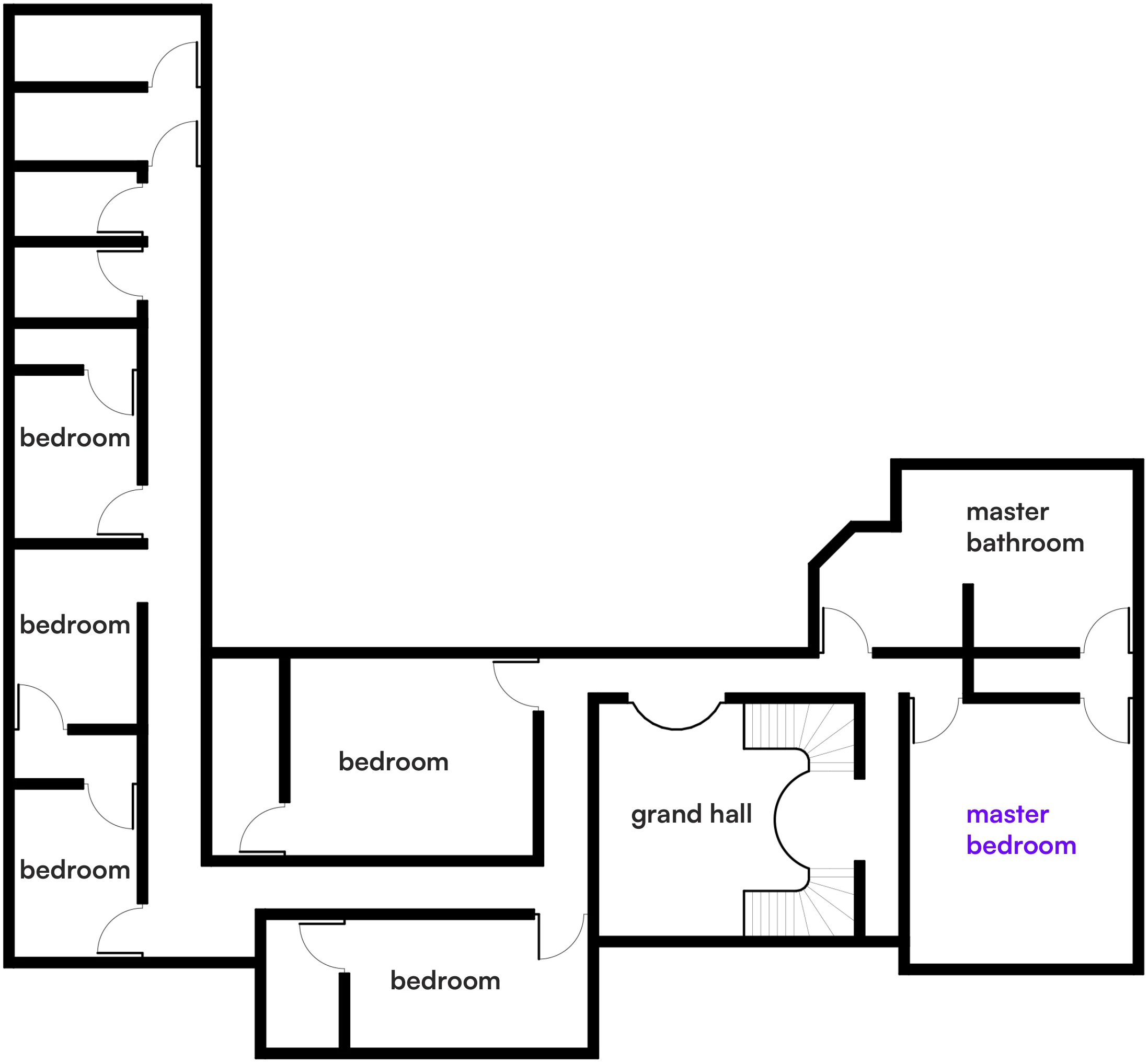
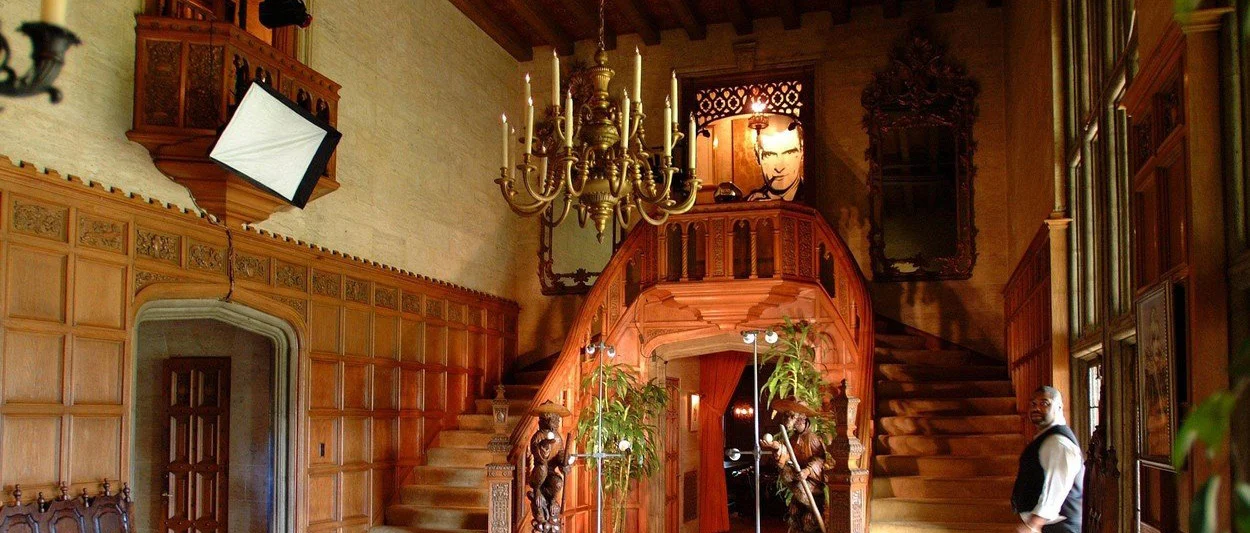
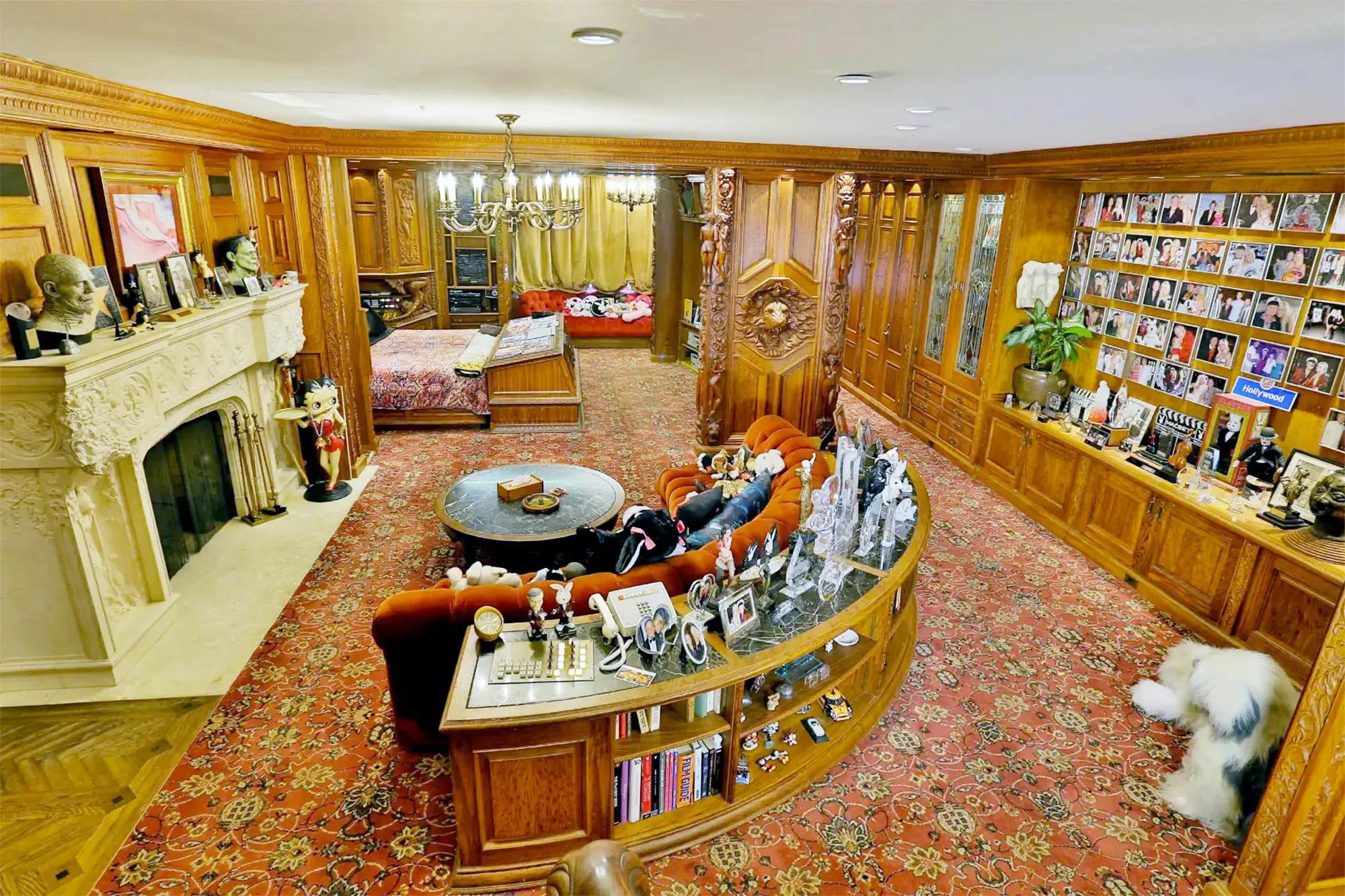
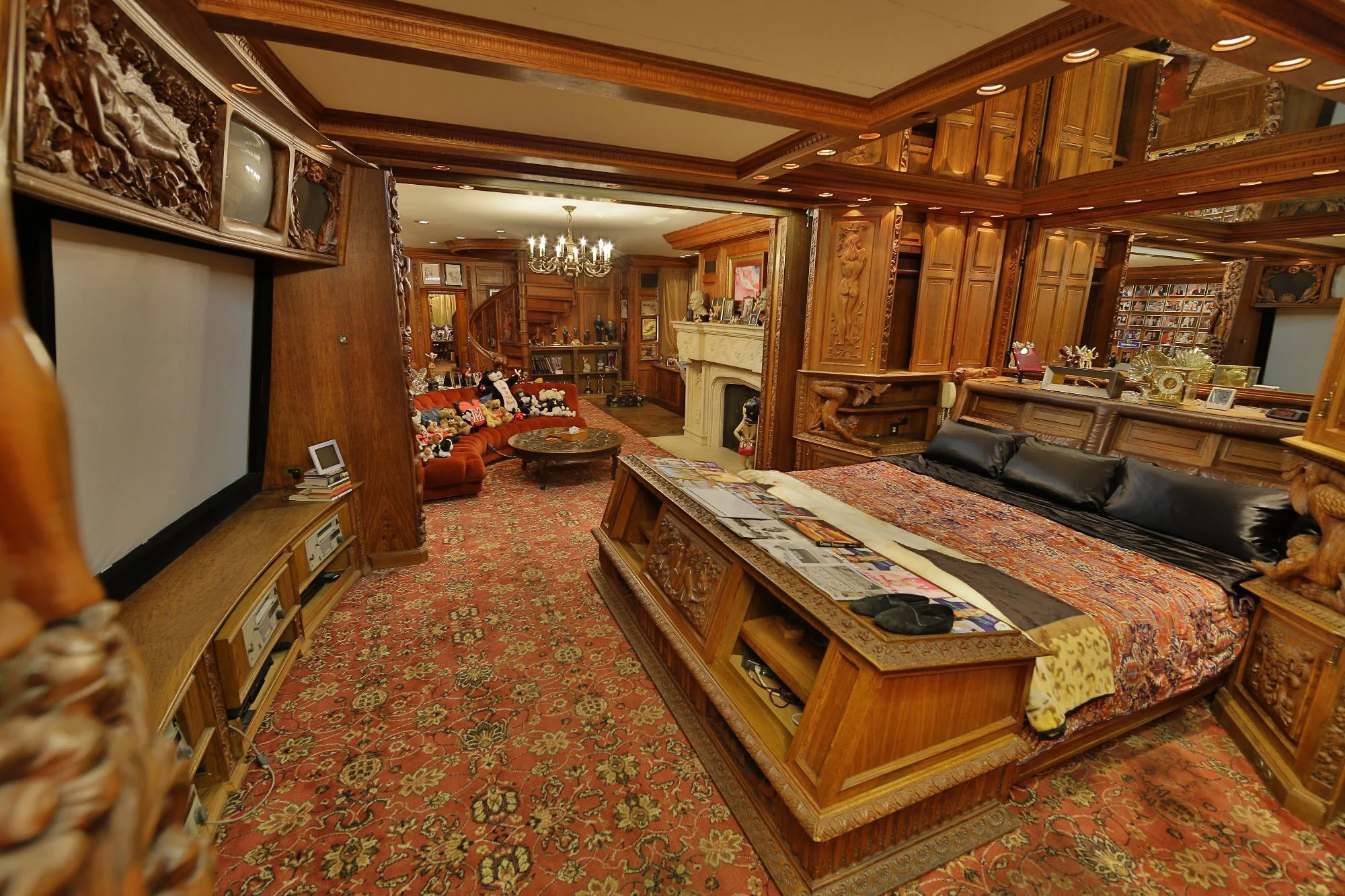
The master bedroom of the Playboy Mansion represents a highly mediated interior, in which privacy is constructed, visibility is controlled, and spatial hierarchy is enforced. The bedroom is located on the upper level and is accessed via the Grand Hall staircase deck (figure 3). The entry is suspensefully concealed behind an arch; the room is not visible from the staircase or the entry point of the deck. Notably, the upper floor houses bedrooms only, vertically segregated from public space (figure 2). Privacy is thus produced via controlled staging before the room is entered. Within the room, privacy becomes ambiguous. Managed visibility and exposure are ingrained into the interior. The bed, just as the room itself, is concealed upon entry as a central object. From the sofa zone, the sightlines open and extend far beyond the room via integrated media (figure 4). The bed, embedded in an alcove, is framed by built-in controls and outlets with two large screens facing the headboard (figure 5). The interior claims exposure once inside. The bed zone is equipped with a mirrored ceiling and headboard, instantly positioning physical intimacy as a performance (figure 5). The subject is not a hidden inhabitant, but both a central operator and a performer. Overall, what appears as a private retreat is revealed as a mediated interior, whose visibility, hierarchy and subject positioning, established in the register, demand further phenomenological analysis.
Operational Register
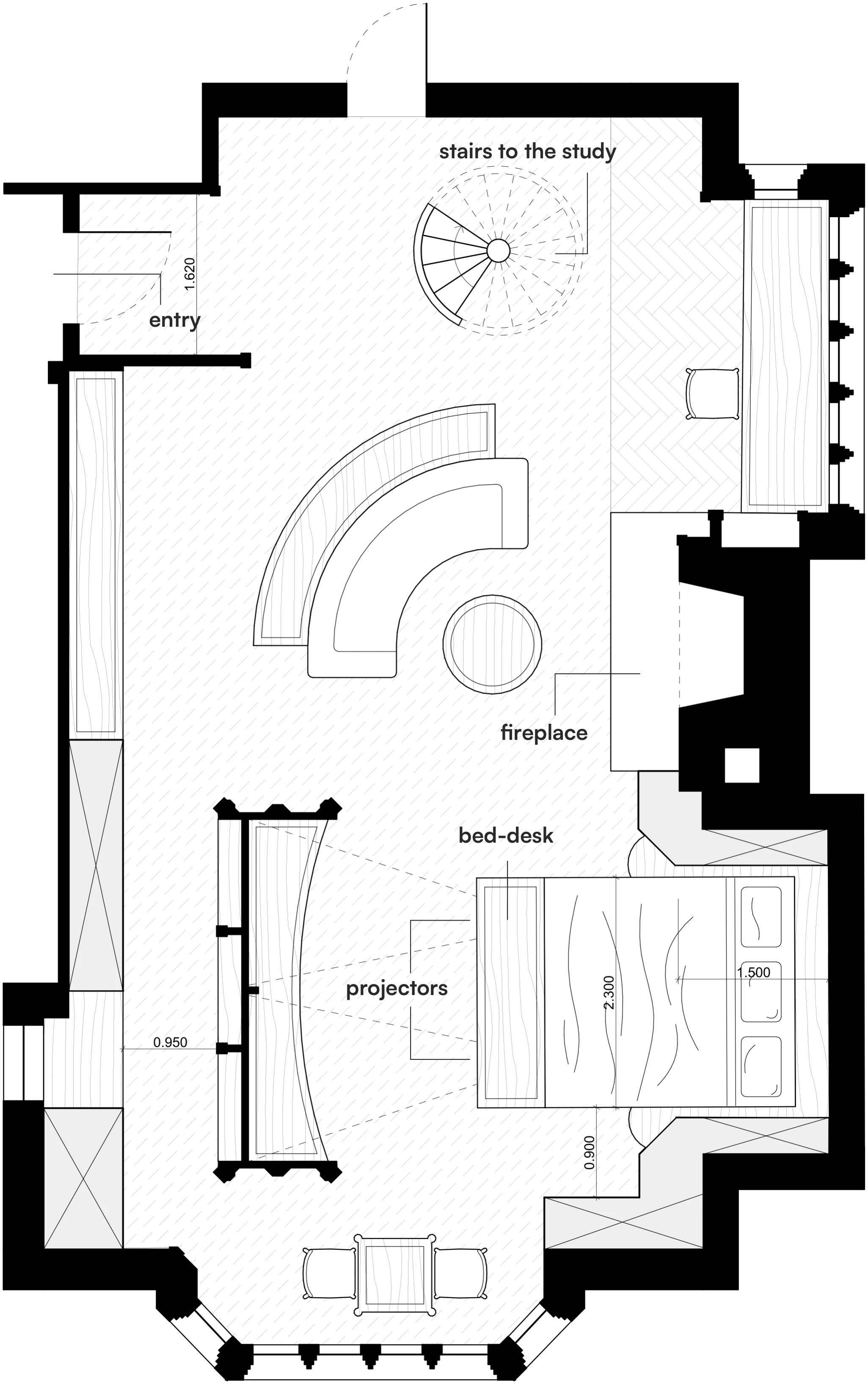
The mediation register positioned the bedroom as staged privacy, bordering on exposure. The operational register, in turn, reveals how the staging is materially enforced. At 87 m² with 3.5 m ceilings, the scale reads ceremonial. Atmospherically, it is paradoxically totalising and heavy, despite assumed airiness. The room is continuous in zoning and elevation with carpet covering most of the area (figure 4). Perceptually, it already suppresses division. The bed establishes itself as a platform with no legs, whilst all the furniture is deliberately grounded to the floor (figure 4). Almost a monumental impression emerges. Full-height mahogany relief panels integrate built-in storage, leaving no blank wall visible (figure 5). The visually dominating Persian carpet is maroon red and densely ornamented, matching the bed sheets. Upholstery matches the carpet tones, with no visible accent anchor. The eye is denied rest. Accumulated atmosphere thus emerges from saturation and not restraint. The lighting enforces said totality, being uniform and artificial. Multiple recessed saucer lights and two chandeliers dominate the interior, leaving no place for shadows (figure 4). Constant visibility and exposure are restated by removing depth. In Hugh Hefner’s bedroom, enclosure is purely symbolic, with simulated containment achieved via framing and density. The bed only appears enclosed within the 1.5 m alcove, while remaining volumetrically open. Linear circulation arranges as an enfilade (figure 1). The inhabitant is exposed and scripted to follow the axial movement. No horizontal surface remains empty; all are covered in chachkas (figure 4). The room atmosphere reads as volumetrically heavy, flattened by illumination, exposed via linear flow and visual saturation.
Process Register
The process register establishes divergences between the spatial performance of the space’s ‘identity’ and lived experience, all within established spatial conditions. The bedroom was previously shown to script and expose the inhabitant’s behaviour. Testimonies from Crystal Hefner (2024) confirm that the bedroom was and felt structured around sexual performance: “It was a performance. I was auditioning for a part.” The played role, however, did not align with the experiential response. Scripted sexuality, present throughout, reportedly coincided with the feeling of detachment: “There was zero intimacy involved.” (Madison, 2015). Detachment may have been exacerbated by the operationally defined perceptual density. First-hand accounts confirm: “Ceiling-high piles of videotapes… stuffed animals… gifts littered the room…” (Madison, 2015). Overwhelm is implied throughout the testimonies when the bedroom is described. Layered on top was the feeling of constant interchangeability reported by guests. The centralised bed-control centre fixes one operator, rendering others secondary: “I was instantly replaceable in this bedroom.” (Hefner, 2024). Overall, affects are proven to stem from operational and mediational qualities of the given space. Detachment, overwhelm, and interchangeability emerge across testimonies, as a result of spatial amplification. Spatial intentions in this case remain inconsistent with the interior’s experiential functions.
Imaginal Register
The process register revealed experiential affects, divergences between them and the spatial scripting. The imaginal register clarifies how said divergences are produced by the bedroom’s intimate spatial figures. When applying topoanalysis as a method, Hugh Hefner’s bedroom cannot be read as a ‘nest’ with adjacent notions of retreat, given its enclosure is only symbolic. Instead, the spatial figure is staged to intensify visibility. The dominant bed is positioned in a rectangular alcove, which is simulated as a ‘shell’. This is exacerbated via storage wrapping around the bed with thickness in furniture and ornament. The ‘shell’ is false in Bachelard’s (1957) terms, given that it is supposed to become a place of withdrawal and reverie. That is not applicable to the bedroom zone, as it is a focal object of performance, with experiential tension present. From the sofa zone, the bed is seen obliquely, appearing altar-like (figure 4). Theatricality is heightened by the attached desk at the foot with magazines spread throughout. Evidently, from the alcove’s angled storage edges and linear circulation to the bed, geometry funnels, intensifying approach. This way, withdrawal and reverie are inverted into a focalised spectacle. The mirrored ceiling, aligned to the bed footprint (figure 5), only reverberates sexual performance, explicitly lit and visible. From imaginal figures of ceremonial ‘altar’, rejected ‘nest’, ‘stage’, and false ‘shell’, this reading produces a topoanalytic diagnosis of typological inversion. The bedroom, while appropriating imagery of protection, organises intimacy as display. The bed is re-scripted from the site of reverie into orchestrated spectacle.
Synthesis
Across mediation, operational, process and imaginal registers, the Playboy Mansion master bedroom emerges not as a place of retreat, but as a calibrated apparatus of visibility. The room methodically simulates enclosure, while reinforcing exposure. Its inhabitant is positioned as a central operator within a regime of scripted staging and axial zoning hierarchy. Centrality and performance are operationally enforced through heavy perceptual saturation and the elimination of depth along with airiness. The room’s hierarchy, overall, is revealed as architectural and intentional, not incidental. Testimonies prove the affects caused by space, describing detachment, interchangeability and overwhelm. Next to bodily affects, imaginally, the room rejects the figure of ‘nest’, resorting to a simulated ‘shell’, where intimacy is scripted. The figures of ‘stage’ and ‘altar’ are more applicable to Hugh Hefner’s bedroom. Testimonies fully attest to the room feeling like a performance mechanism with the bed being central. Thus, imaginal figures are embedded in produced experience. Across registers, the Playboy master bedroom demonstrates methodological coherence, as each reading reinforces a regime of staged enclosure and exposure. Enclosure exists without withdrawal. Visibility is intensified, never softened. Intimacy is staged, not inherent. The space sustains a system in which hierarchy, saturation and focal centrality converge without contradiction.
Sainte-Marie de La Tourette Monk Cell
Mediation Register
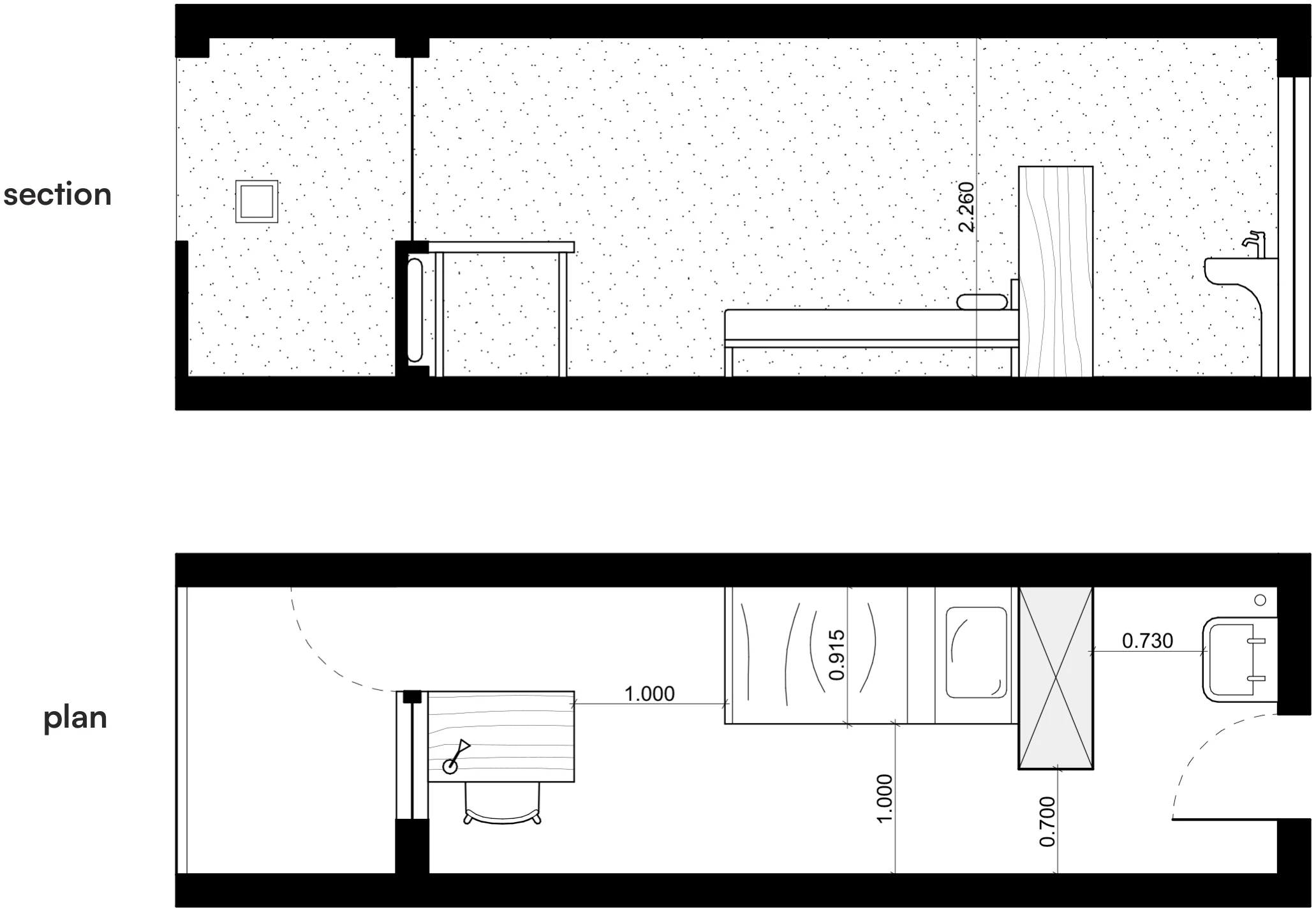
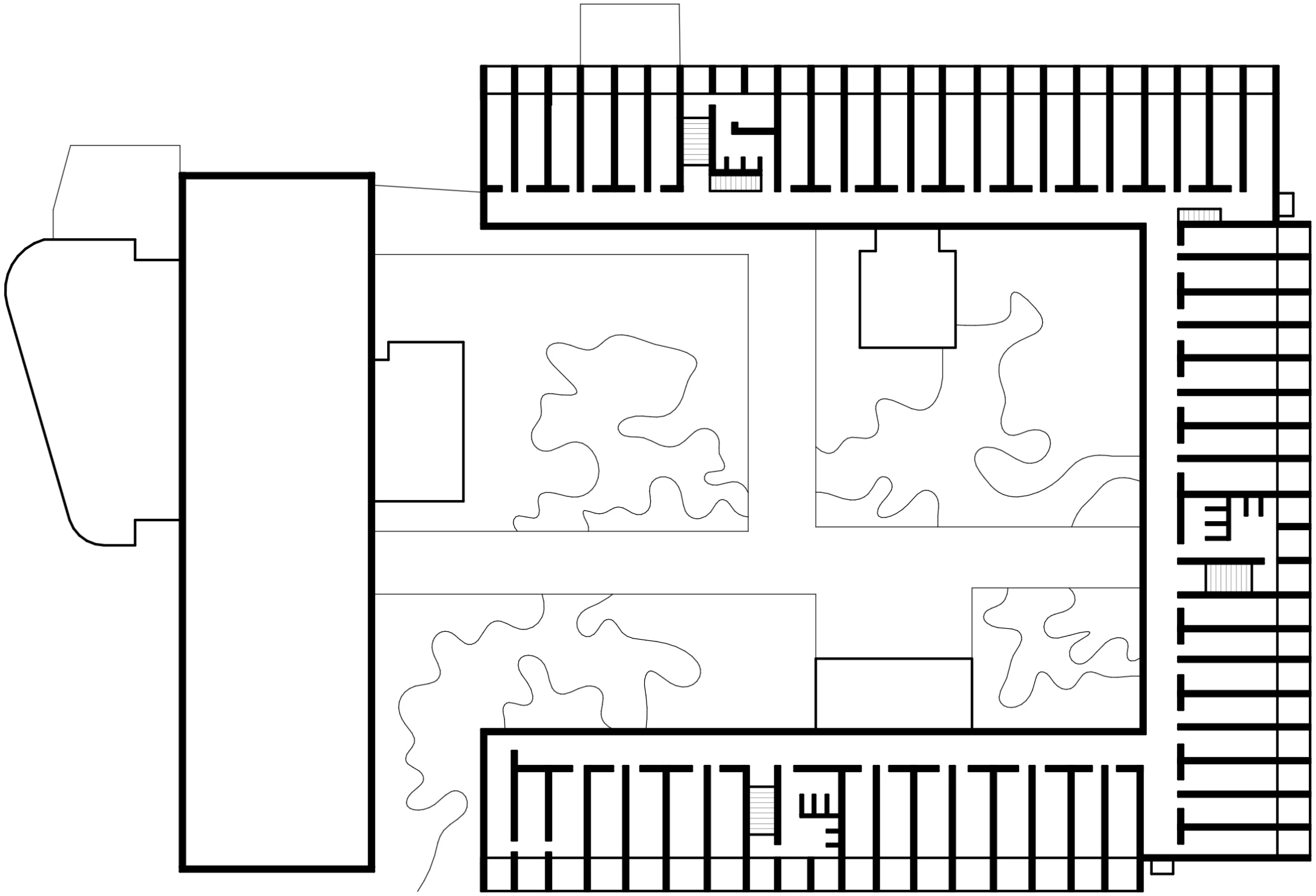
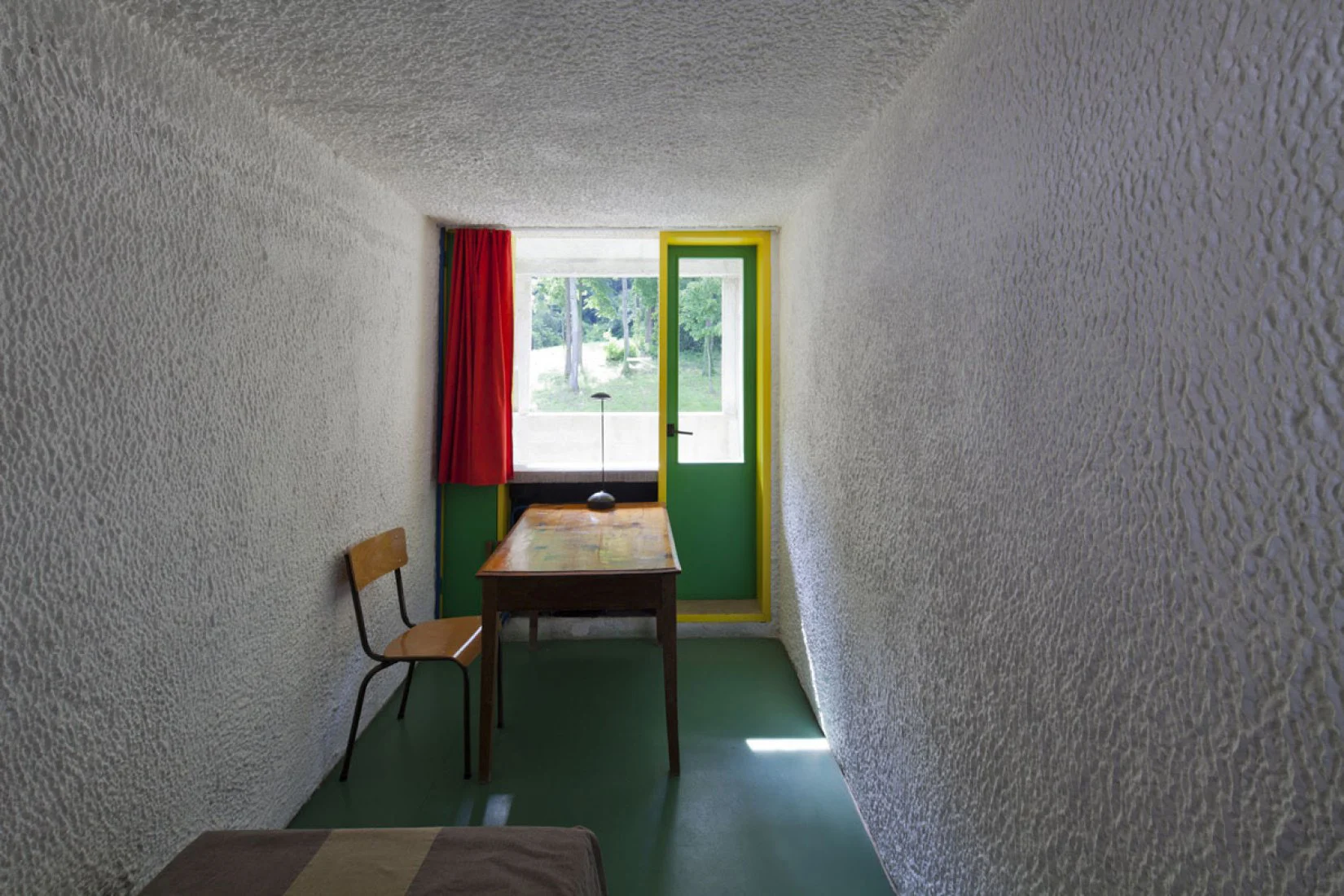
The typical monk cell of Sainte-Marie de La Tourette is mediationally a unit of a regulated visibility regime. Structured through repetition and threshold control, it embeds privacy within the institutional order of the monastery. The cells are accessed through the long P-shaped corridor with linearly aligned doors (figure 7). From the front door, the bed is occluded via a closet that isn’t full height, but still opaque. The only glimpses behind the closet are partial – desk and creeping window light (figure 6). The entry represents privacy as produced, not inherent. The cell balcony threshold is fully glazed with the view directed toward the courtyard landscape (figure 9). The balconies are also fully separated by lateral walls, though they include a very small side window, limiting exposure (figure 6). This positions the inhabitant as an outward observer, not someone who is seen. The desk is directly adjacent to the window from the side, while the bed is fully visible laterally (figure 9). Heavy blinds further regulate exposure. The visual regime thus remains disciplined and directed, not expressive or staged. Overall, the mediation register establishes the monk cell as a disciplined visual apparatus with an outward gaze. Privacy is regulated through occlusion and the positioning the inhabitant as an observer, not a spectacle. The identified privacy and visual regulation are supported by precise bodily calibration and other spatial conditions reviewed further.
Operational Register
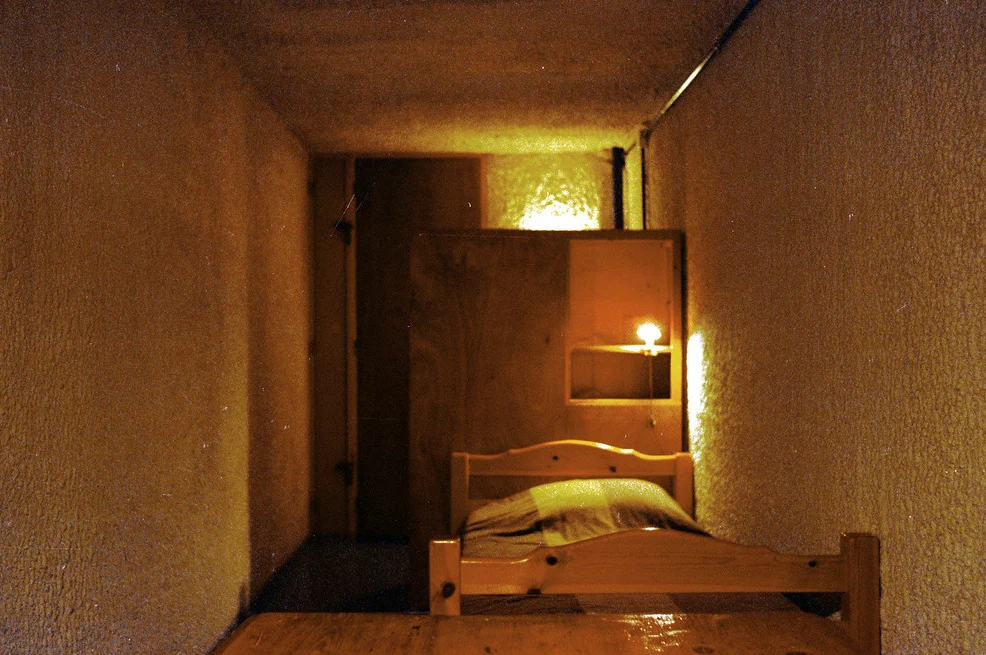
Operationally, privacy is further positioned as containment. The cell’s dimensions directly correspond to reach and relative proportion. The ceiling is exactly the raised arm height. The width of the room is modulated through two arms extended laterally (figure 6). The minimal clearance near the closet is 70 cm, which is in turn essential and doesn’t require bodily rotation. The bed circulation zone of 1 m clearance is generous for a single body, but not for dual occupancy (figure 6). The space is not compressed but rather bodily calibrated. The balcony reinforces containment by resisting spatial expansion. Its threshold is flush. Its lateral walls are continuous. Its overhead slab does not allow for volumetric release (figure 9). The storage is limited to one closet. Most surfaces remain empty. Furniture is limited to living essentials such as bed, desk, chair, with no decorative accumulation (figures 8, 9). Restraint reads throughout the interior, reinforcing perceived austerity. Daylight is the active agent of depth accumulation within the room. The lighting is modulated as it slowly diminishes toward the back of the room (figure 8). Materials, in turn, do not rely on flat exposure but utilise the shadow play through absorption and reflection. Rough white stucco of the walls and the ceiling consumes and contains light, while the glossy uniform green floor mirrors it throughout the room (figure 9). The balcony slab shades the exposed zone, diffusing direct light. It is notable that most surfaces described do not absorb sound but reflect it, allowing the building to reverberate. Across defined variables, the operational register reveals a spatial system calibrated to a single body through restraint and contained extension. The room produces spatial depth and selective visibility via filtered daylight. These conditions do not produce ease but generate perceptual tension.
Process Register
The monk cell produces perceptual and somatic tension through defined operational variables. Rowe (1961, cited in Vidler 2012, p. 14) describes the stay at La Tourette as “unexpected as it is painful,” alluding to what is later described experientially as “divided consciousness”. With no immediate axial presentation upon entry (defined in mediation), perception is denied stabilisation. Spatial comprehension is delayed further, as the space is experienced laterally. Inside the cell, Rowe (1961, cited in Vidler 2012, p. 13) defines “a movement from the brilliance and lateral extension … to the relative darkness and lateral closure of the cells.” This produces containment, reinforced through modulated light distribution along with spatial depth and narrow proportions. Klinkhammer (p. 5, 2009) adds to the sentiment, describing the cells as “grotto-like”. While light limits visual field, material hardness and reflectivity prevent sensory quiet. Bell (2017) reports that the building “reverberates with every action…” making silence acoustically active. Documented accounts describe discomfort, with somatic ease being restrained rather than facilitated. Bell (2017) further describes cells as “freezing cold” given minimal insulation. Restraint is structurally reinforced via solitude as an architectural condition. Klinkhammer (p.5, 2009) notes that the cell is framed as a space of “silence and solitude”. Within the process register, the monk cell sustains perceptual destabilisation and somatic alertness, maintaining disciplined containment without resolving into atmospheric ease. The defined affects further converge into imaginal figures in the following reading.
Imaginal Register
The imaginal register condenses defined affects and operational conditions toward the true ‘shell’. ‘Nest’ and ‘inhabited corner’, though typologically implied, are not present. Geometrically, the desk is positioned in a corner, but no recess or thickened niche exists; surfaces remain planar and acoustically exposed. The bed is laterally visible, not recessed and subordinated to desk and balcony orientation (figure 9). No component functions as inhabited retreat or a place for reverie to manifest. Documented accounts report sleeplessness and cold, rather than repose (Bell, 2017). The interior is revealed as a hard enclosure with calibrated containment enforced throughout. Hard concrete surfaces, acoustic reflectivity, thermal austerity, and narrow proportion reinforce this rigidity. Therefore, the ‘shell’ best describes the dominant intimate figure within the La Tourette cell. The balcony becomes a secondary imaginal figure, acting as a displaced hollow. Lateral walls and overhead slab continue the shell into a controlled opening (figure 9), bringing enclosure outward. The cell imaginally displaces shelter towards the exterior threshold, still containing it. Within the imaginal register, the monk cell functions as a disciplined shell with an outward flow, sustaining enclosure without producing the intimate ‘nest’ of reverie.
Synthesis
Across mediation, operational, process and imaginal registers, the Sainte-Marie de La Tourette monk cell operates as a coherent mechanism of reinforced containment. Visual regulation and constructed privacy, bodily calibration, perceptual tension, and imaginal enclosure converge, collectively resisting expansion. The inhabitant is positioned as an observer within the institutionalised order of identical units stripped of individuality. Enclosure and interior austerity are further embedded through proportion, modulated light, and overall restraint in both materials and objects. Documented accounts prove experiential derivations of affect, describing perceptual destabilisation, somatic unease, silence and solitude as enforced states. The true ‘shell’ figure condenses all outlined conditions, producing rigid enclosure on the imaginal level. The balcony introduces a controlled exterior horizon and extends enclosure without disrupting containment. The outward gaze remains framed by the box-like opening, producing the ‘shell’ orientation toward the external cavity. Due to acoustic exposure and structural repetition of contained units, solitude becomes architectural, not incidental. Single body calibration further enforces isolation. Across registers, the monk cell demonstrates methodological coherence, sequentially reinforcing the same architectural condition of disciplined enclosure. The space sustains a calibrated regime in which shell-like containment, enforced silence and solitude, somatic discomfort, converge without contradiction. Further will follow the synthesis and comparison of findings from both studies.
Comparing the Bedrooms
Although both bedrooms demonstrate internal coherence across mediation, operational, process and imaginal registers, they produce inverse architectural regimes. The Playboy Mansion master bedroom simulates enclosure while operationally intensifying exposure; the monk cell of Sainte-Marie de La Tourette operationally embeds enclosure while restricting imaginal refuge. At mediation, the Playboy bedroom’s privacy is staged through controlled revelation of a focal spectacle, positioning the inhabitant as a central operator within axial hierarchy. The monk cell, on the other hand, positions the inhabitant as a single observer within a regime of occlusion and repetition. Both bedrooms regulate visibility, but one centralises performance while the other suppresses spectacle. Ceremonial scale, lighting and surface saturation of the first interior produce volumetric exposure, where enclosure is only symbolic. The second interior emphasises calibrated proportion, restrained material palette and differential light distribution to produce containment, where expansion is structurally prevented. The Playboy bedroom enforces exposure through excess; the cell enforces containment through reduction. Testimonies regarding Hugh Hefner’s bedroom report detachment, performance, interchangeability and perceptual overload, aligning with spatial scripting. By contrast, the monk cell visitors described it as cold, reverberating, with divided perception and disciplined solitude, aligning with calibrated restraint. The first case generates affect through spectacle and saturation; the second through containment and sensory restriction. Across the first three registers, both interiors demonstrate methodological consistency, yet their spatial logics operate in opposite directions.
The divergence crystallises in the imaginal register, where each bedroom condenses its spatial logic into a distinct dominant figure. Hugh Hefner’s bedroom appropriates the false ‘shell’ as staged spectacle. The bed-alcove simulates thickness but remains open. The mirrored ceiling multiplies visibility. The circulation funnels toward the bed. The ‘shell’ is false and enclosure masks exposure, and the bed is re-scripted imaginally from refuge into ‘altar’. The La Tourette cell materialises the true ‘shell’ as disciplined enclosure. The hard concrete envelope is dominant with balcony as a displaced hollow. Testimonies confirm cold and reverberation, rather than reverie, which differentiates the shell from a nest. The shell is thus materially embedded, with enclosure restricting expansion, not producing intimacy. From the concluding register, typological inversion and reduction emerge as phenomenological conditions. The Playboy bedroom organises imagery of protection as a spectacle, resisting the nest figure application. The latter is true for the monk cell, though reductively in comparison. There, intimacy is not simulated, but structurally disciplined, resisting individualisation and retreat. Overall, the typology does not guarantee reverie. Intimacy becomes contingent upon visibility, bodily calibration, sensory modulation and imaginal condensation. Through the same four-register method, both cases reveal how spatial mechanisms precede symbolic interpretation. One bedroom exposes enclosure as performance; the other enforces enclosure as discipline. The divergence confirms that phenomenological experience is not inherent but structurally produced.
Conclusion
The analysis of the Playboy master bedroom and the La Tourette monk cell saw two opposite phenomenological regimes, coherent internally yet structurally divergent. With bedroom typology taken as a medium, it was shown that cultural scripting does not guarantee intimacy or reverie as phenomenological conditions. In essence, the sequential analysis produced detailed diagnosis of each phenomenological space. The mediational register exposed visibility politics and privacy construction, while the operational register revealed architectural language and atmospheric calibration. The process register validated produced affect, while the imaginal register condensed spatial and perceived logic. Typologies can be inverted and rejected experientially, dependent on spatial to affect qualities. As seen, phenomenology is carefully constructed on multiple parallel levels in the given case studies. Phenomenological assembly, overall, was proven overarching in space – subject relations and intentionally non-reductive.
The analysis sequence positioned several claims in relation to broader studies and definitions of phenomenology. Privacy is indeed architecturally produced, where visibility is never accidental but pre-distributed. Within mediational constraints, atmosphere is operational and calibrated to produce experiential functions. Space acts as a strong amplifier of secondary or unconscious processes, directly correlated with spatial conditions. Imaginal figures condense spatial and experiential qualities into an overarching channel, either confirming or rejecting spatial intentions of inhabitation. The methodology has proven effective in dissecting and retrospectively tracing existing phenomenological assembly. Its value, however, goes beyond as it could be utilised as a core design driver to avoid the highlighted divergences between spatial intention and experiential affect.
Experiential qualities, if not grounded, are elusive and complex to define, especially to design. This essay demonstrates that phenomenology can be defined, traced, produced, and integrated. The developed methodology can be restructured from what appears as an analysis structure into what would be defined as a conceptual design sequence. This way, design is able to not only introduce experiential aims but to fulfil them via spatial language, correlated with both imaginal and affective dimensions. The value of this theoretical methodology lies in furthering human-centric design in future architectural production.
Reflections, Afterword
Contemporary architecture often prioritises ‘fashionable’ metrics of striking image, social programme, and sustainability. While those are important considerations, actual human experience becomes more rhetorical than intentionally constructed. This research suggests that experience can be assembled with clearly defined affective aims. Atmosphere is thus never accidental nor inherently typological or culturally scripted. It can be and is assembled via spatial variables, whether intentional or not. However, the control I am suggesting does not equal manipulation. There is ethical dimension to human-centric design in visibility, isolation, and scripting. What is intended should follow best interest of the intended aimed affect to further position architecture as a driver of global health.
Architecture is proven to be not a container but an amplifier, not a backdrop but condition. Designers are therefore responsible for shaping experience consciously, recognising mediation and anticipating imaginal figures. Phenomenology overall is proven to be not intangible poetry alone, but a regulated medium that can and should be considered in any design going forward, as aims to produce beneficial spaces are set. Psychological implications of space cannot be denied, and this essay has established the exact link between what space is and what it does to the inhabitant unconsciously.
I want to restate:
EXPERIENCE IS NEVER GIVEN BUT BUILT.
ARCHITECTS MUST BE CONSCIOUS OF WHAT EXPERIENCE THEIR DESIGN PRODUCES.
Appendix
Bibliography
Bachelard, G. (1958) The Poetics of Space. Translated by M. Jolas. Boston: Beacon Press. (Original work published 1957.)
Bell, J. (2017) The architecture of silence: Cistercian abbeys and monastic life. London: Thames & Hudson.
Colomina, B. (1992) ‘Sexuality and Space’, in Colomina, B. (ed.) Sexuality and Space. New York: Princeton Architectural Press, pp. 73–98.
Colomina, B. (1994) Privacy and Publicity: Modern Architecture as Mass Media. Cambridge, MA: MIT Press.
Doctor Casino (2008) La Tourette – my cell for the night [Photograph]. Available at: https://www.flickr.com/photos/doctorcasino/2746593697 (Accessed: 11 March 2026).
Hefner, C. (2024) Only Say Good Things: Surviving Playboy and Finding Myself. New York: Gallery Books.
JustHangingByThePool (2023) The Great Hall at Playboy Mansion West. Reddit, r/secretsofplayboy. Available at: https://www.reddit.com/r/secretsofplayboy/comments/1211m97/the_great_hall_at_playboy_mansion_west/ (Accessed: 11 March 2026).
Klinkhammer, S. (2009) ‘Silence and solitude in Le Corbusier’s La Tourette’, Journal of Architectural Theory, 13(2), pp. 1–12.
Madison, H. (2015) Down the Rabbit Hole: Curious Adventures and Cautionary Tales of a Former Playboy Bunny. New York: Dey Street Books.
Mindell, A. (1985) Working with the Dreaming Body. London: Arkana.
Mindell, A. (1993) The Shaman’s Body: A New Shamanism for Transforming Health, Relationships, and Community. San Francisco: HarperCollins.
Modernist Estates (2018) Le Corbusier’s La Tourette. Available at: https://www.modernistestates.com/journal/le-corbusier-s-la-tourette (Accessed: 11 March 2026).
pewp_thexx (2024) Playboy Mansion layout. Available at: https://www.reddit.com/r/secretsofplayboy/comments/1ey7zkx/playboy_mansion_layout/ (Accessed: 11 March 2026).
The Sun (2018) Hugh Hefner’s boudoir items from the Playboy Mansion auction. Available at: https://www.thesun.co.uk/news/7803693/hugh-hefner-boudoir-playboy-sale/ (Accessed: 11 March 2026).
Vidler, A. (2012) James Stirling: Notes from the archive. New Haven: Yale University Press.
Zumthor, P. (2006) Atmospheres: Architectural Environments – Surrounding Objects. Basel: Birkhäuser.
Zumthor, P. (2010) Thinking Architecture. 3rd edn. Basel: Birkhäuser.